
Developed by Thomas R. Bruce, Cello, the first internet browser for Microsoft Windows, more precisely for Windows NT 3.5, was introduced on 8th June 1993. Easy-to-use Cello did not live to be one-year-old ? further development was abandoned in April 1994, barely 11 months after Cello had been released.
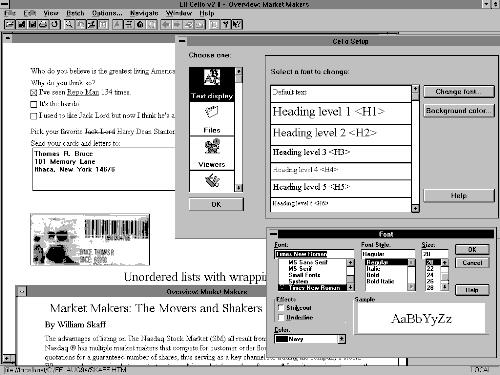
Cello?s history and development goes back to the early 1990s. Tim Berners-Lee developed the first web browser called WorldWideWeb, which was later renamed Nexus to avoid confusion, and released for the NeXTstep platform in 1991. By the end of 1992, other browsers, mostly based on libwww program library, were released. Unix platform featured options to choose between Line-mode, ViolaWWW, Erwise or MidasWWW, while MacWWW/Samba ran on Macintosh computers. New browsers appeared in 1993, for instance, Cello, Arena, Lynx, and Mosaic. Multi-platform Mosaic (http://archive.ncsa.illinois.edu/mosaic.html), developed by NCSA (National Center for Supercomputing Applications, USA), had the most powerful impact. In 1994, visitors accessed web pages mostly using either Mosaic or Cello, the latter being easier to use, and having fewer system requirements. After its release, Cello soon had a daily average download of 500, and was used by 150-200 thousand people.