
 Punched cards and similar systems were used in the field of automation and data processing already in the mid-18th century. It was most of all used to control processes that repeated in a sequence. Among other things, looms were controlled by punched cards, which were made of wood at the time. Street organs were also controlled by a recording medium similar to punched cards, and the same solution was adopted in other related automatic or semi-automatic musical instruments. Charles Babbage intended to use punched cards to programme his Analytical Engine.
The origins of punched cards go back to the operation of music boxes. In these and in similar automatons, there was a revolving cylinder with holes to programme the sequence music was played or to control other mechanical processes.
When 20th-century computers were developed, punched cards offered an obvious solution to programme and data input. Zuse Z1, the first computer built by Konrad Zuse, operated using instructions encoded in punched tape. However, computers used Hollerith cards almost exclusively later on.
 Punched cards that could be used manually existed even until the late 1990s. For instance, punched cards with holes along the four sides were in use in libraries. By inserting a long needle into the hole for the search category, library cards that met the search criterion could be selected. Search for multiple categories could be done by using a number of needles.
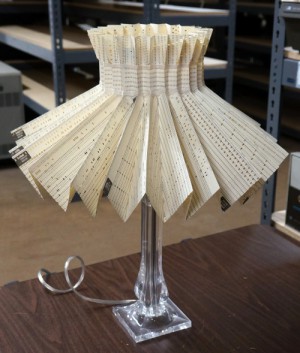
Punched cards evoking the pioneering time in computing history inspire artists even today. Amelia Roberts, one of the archivist of Living Computer Museum in Seattle, creates special objects, for instance lamp shades, making use of punched cards, the computer age scrap. These creations are on display in the museum from 15 January.