
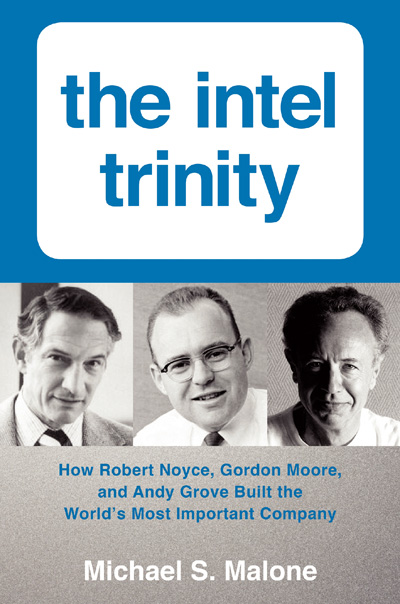
On 15 July, Michael S. Malone, the well-known technological writer (or science writer) came out with a 560-page, hardcover book with the title The Intel Trinity: How Robert Noyce, Gordon Moore, and Andy Grove Built the World’s Most Important Company. Reviewers say it is entertaining reading as Malone brings life to what happened, provides an accurate description of the background thanks to his extensive connections, and tells fascinating stories about the road to personal computers, the internet, and permanent digital revolution.
Such books are always needed, and in our universe of Google, Facebook, and Twitter, they are all the more welcome as we tend to forget about the beginnings, about inventions and developments that made the way for our world today. These changes were brought about by Robert Noyce (1927-1990), once nicknamed as the “Mayor of Silicon Valley”, who also contributed to the realisation of the first integrated circuit, and by his colleagues, who left Sockley Semiconductor Laboratory in September 1957. The “traitorous eight” founded Fairchild Semiconductor, a defining company in the semiconductor industry, in 1960, and started up and brought to flourish a number of other companies including Intel and AMD.
The “traitorous eight” quit their jobs at Shockley Semiconductor Laboratory in Mountain View, and this act more or less marks the beginning of Silicon Valley in today’s sense. On 18 July 1968, Intel was founded by Noyce, Gordon Moore, known for his law, and venture capital investor Arthur Rock. Alongside with Noyce and Moore, Hungarian-born Andy Grove also played a key role in the story of the company. Noyce was a charismatic leader, Moore worked out the law about the pace of innovation, and Grove was “the greatest and most ferocious businessman of his generation” as Malone puts it. It is thanks to this trio that Intel achieved historic success.